| . |
United Nations Climate Change Conference - Nairobi 2006
6 - 17 November 2006
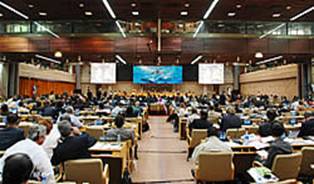
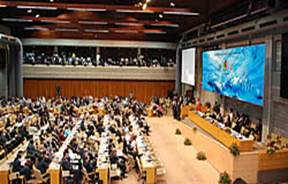
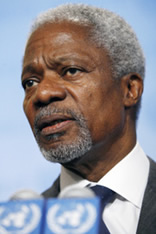
Kenya is hosting the second meeting of the Parties to the Kyoto Protocol (COP/MOP 2), in conjunction with the twelfth session of the Conference of the Parties to the Climate Change Convention (COP 12), in Nairobi from 6 to 17 November 2006. The conference will also include, from 6 to 14 November, the twenty-fifth session of the Subsidiary Body for Scientific and Technological Advice (SBSTA 25), the twenty-fifth session of the Subsidiary Body for Implementation (SBI 25), and the second session of the Ad Hoc Working Group on Further Commitments for Annex I Parties under the Kyoto Protocol (AWG 2) including an in-session workshop. President of Kenya, Mwai Kibaki
and UN Secretary-General Kofi Annan will open the High Level Segment of the Conference on Wednesday, 15 November.
The opening will be web cast live on the Internet and broadcast on TV by Kenya Broadcasting Corporation.
In addition, ninety-two ministers from around the world are expected. The second meeting of the Parties to Kyoto Protocol (COP/MOP 2) and twelfth session of the Conference of the Parties (COP 12) are set to conclude on 17 November 2006.
Nairobi
United Nations Climate Change Conference opens with warning that climate
change may be most serious threat ever to face humankind
Kyoto
Protocol set to help green economies of eastern and central Europe The United Nations Framework Convention on Climate Change (UNFCCC) launched a new mechanism of the Kyoto Protocol expected to generate significant reductions in greenhouse gas emissions which cause global warming. With the launch of the Kyoto Protocol’s joint implementation (JI) mechanism, developed countries will be able to acquire carbon credits from greenhouse gas emission reducing projects undertaken in other industrialized countries, in particular central and eastern European transition economies.
UNFCCC Executive Secretary calls for new climate compact to combat global warming
According to UNFCCC Executive Secretary Yvo de Boer, the world urgently needs a long-term legal framework to provide security for carbon markets. Speaking at the international conference “Make Markets Work for Climate” in Amsterdam, the Netherlands, Mr. de Boer also said that a new global initiative to combat climate change would be the solution to generate financial flows between the North and South required to effectively tackle global warming. On Thursday, COP/MOP reconvened to finalize its agenda and to consider issues relating to the CDM, the Joint Implementation Supervisory Committee, the Compliance Committee, a proposal from Belarus to amend Annex B of the Protocol, and the Russian proposal on voluntary commitments. On Saturday, delegates met in contact groups and informal consultations on a range of issues, including the adaptation programme of work, Annex I and non-Annex I communications, AWG, the Belarus proposal, capacity building, deforestation, education and public awareness (UNFCCC Article 6), HCFC-22 and HFC-23, privileges and immunities, research and systematic observation, response measures, review of the Protocol (Article 9), and technology transfer.
José Domingos Gonzalez Miguez, Chair of the CDM Executive Board, reported significant growth in the use of the CDM in the past year and a significant increase expected in the Board's workload over the next 12 months. |
|